As the core component of a rocket engine,the thrust chamber performs the critical function of converting the thermal energy of high-temperature gas into kinetic energy to provide thrust for flight. Its performance directly determines the engine’s operational capability and reliability. Traditional manufacturing methods, limited by processing techniques, struggle to create complex cooling channels, which constrains the improvement of engine cooling efficiency and overall performance. Metal 3D printing technology has brought a breakthrough to thrust chamber manufacturing leveraging its advantage of freely forming complex structures. BLT has overcome the forming process challenges for large-scale copper alloy components and developed a copper inner wall liner for the thrust chamber. This innovative achievement will be exhibited at Formnext 2025 in Germany, demonstrating to the industry the application results and broad prospects of metal 3D printing in cutting-edge aerospace manufacturing.
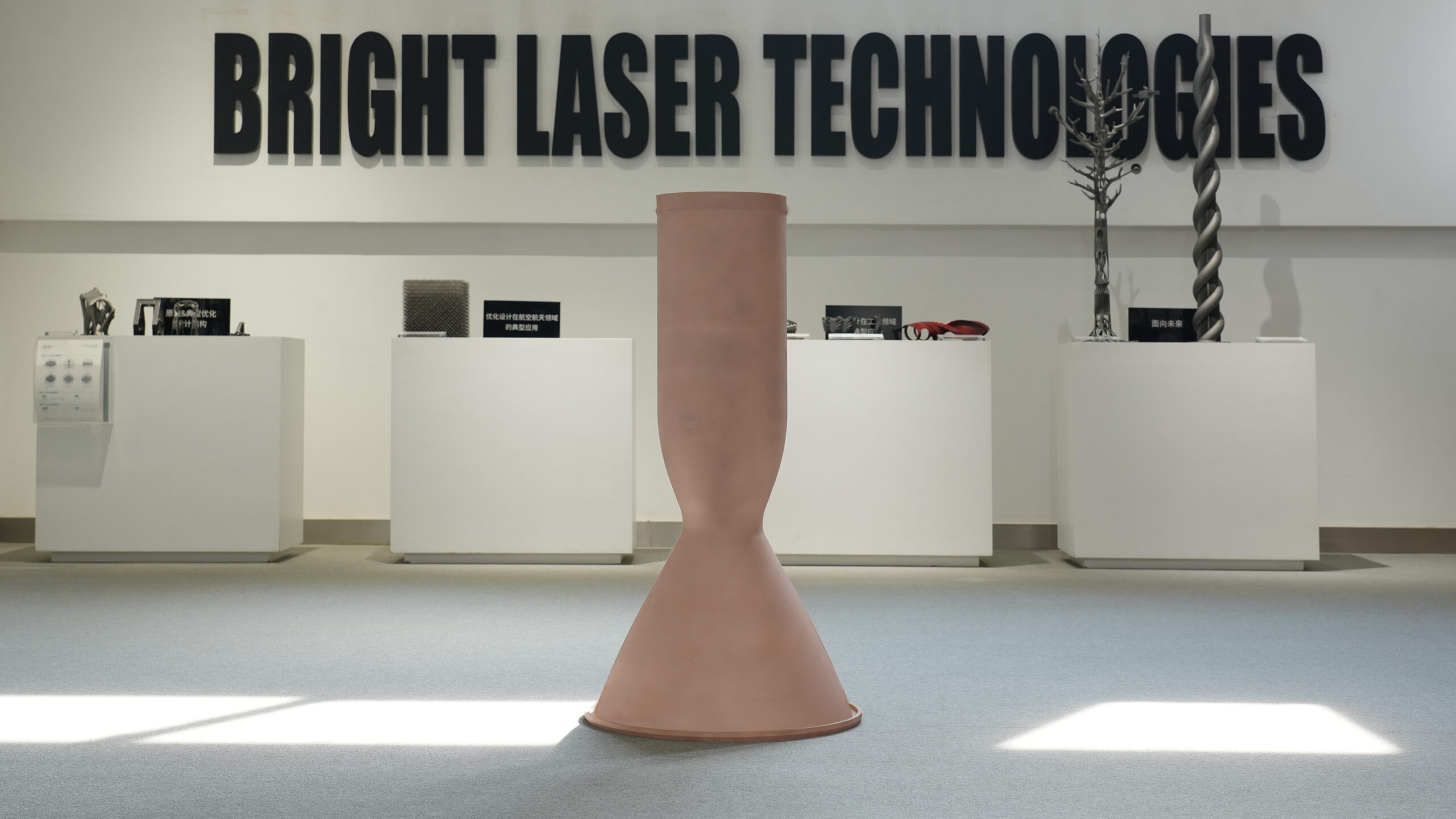
The copper inner wall was integrally printed on six-laser BLT-S615 from high-performance CuCrZr powder.With final dimensions of φ502 mm × 946 mm and a weight of 35 kg, this component demonstrates BLT’s strong capability in the precision forming of large-scale, complex-flow-channel structures.

High-Performance CuCrZr Alloy: The Cornerstone of Part Reliability
The component utilizes CuCrZr (Copper Chromium Zirconium), a precipitation-hardened copper alloy with a copper matrix micro-alloyed with elements such as chromium and zirconium. This material retains the excellent thermal conductivity of pure copper while offering significantly enhanced strength and hardness, along with good high-temperature deformation resistance and corrosion resistance. This combination of properties ensures that the thrust chamber’s inner wall can achieve efficient heat dissipation while maintaining structural integrity and stability under extreme service conditions of high temperature and high pressure, thereby guaranteeing the long-term reliable operation of the engine.
Integrally Formed Cooling Channels: Enabling Optimized Heat Dissipation
Traditional manufacturing processes are constrained by machining capabilities, making it difficult to construct complex and intricate conformal cooling channels inside components. These limitations restrict further improvement of the combustion chamber’s heat dissipation efficiency and performance.The complex internal cooling channels within the thrust chamber, monolithically formed by metal 3D printing technology, not only increase the heat exchange area but also ensure uniform coolant flow throughout the passages, thereby preventing localized overheating. This innovative design of complex flow channel structures can significantly enhance the engine’s cooling efficiency and extend its service life, providing an effective solution for heat dissipation challenges in high-thrust liquid rocket engine combustion chambers.
Furthermore, by integrating the cooling channels with the inner wall in a single manufacturing process, the need for traditional welding is eliminated. This not only prevents potential welding defects but also substantially reduces the production timeline.